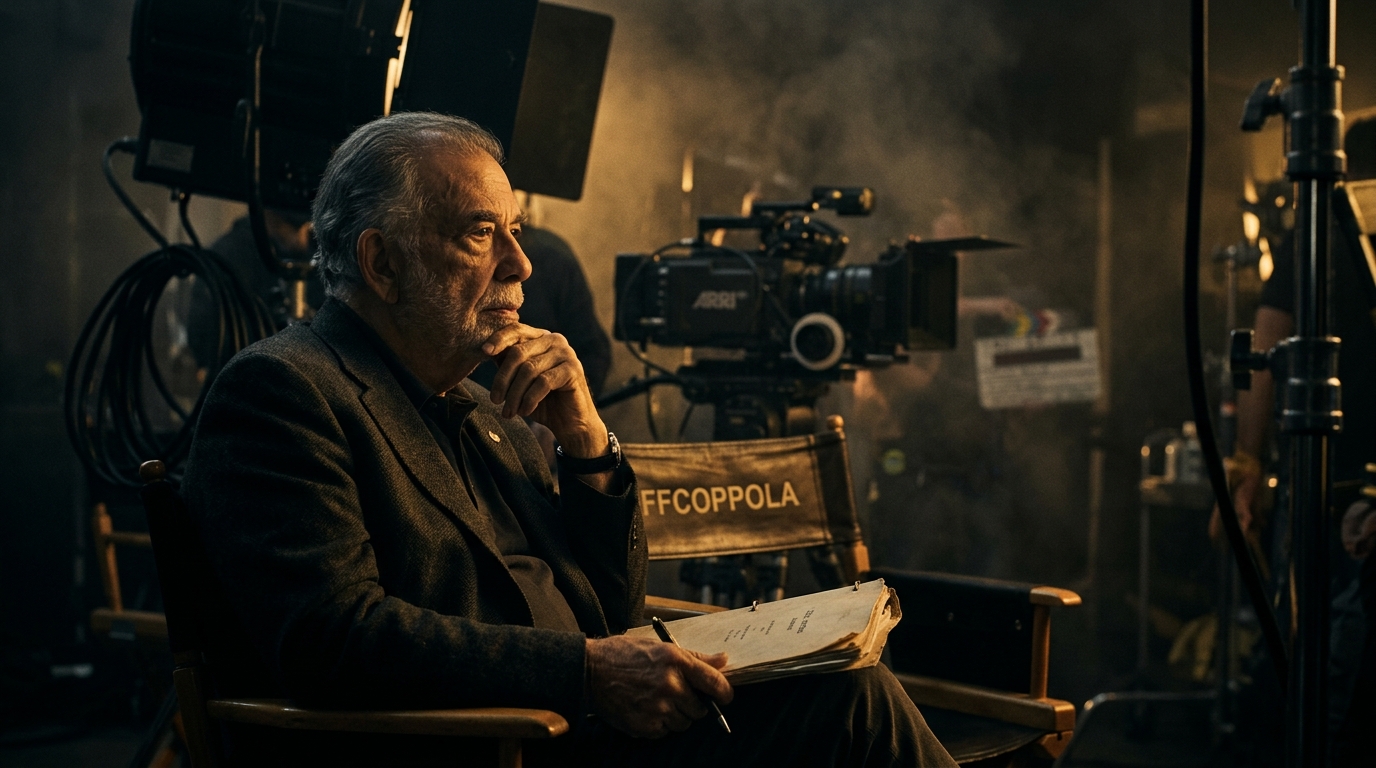
The 4.7-Point Gap
The difference between The Godfather (9.2 IMDb) and Twixt (4.5 IMDb) is 4.7 points. Among directors in our database who have at least one film above 8.5, Coppola's gap between best and worst is the largest. For context: Spielberg's gap is 3.2 points. Scorsese's is 2.7. Kubrick's is 2.8. Nolan's is 1.8.
Coppola doesn't just have range — he has the widest measurable range of any filmmaker operating at the highest levels of the art form.
Standard Deviation: 1.43
Coppola's standard deviation of 1.43 is one of the highest among established auteurs. The average for directors with 10+ films is 0.85. Coppola's variance is nearly 70% above the norm. In financial terms, his filmography has the volatility profile of a speculative growth stock — massive potential returns with equally massive downside risk.
The 1970s Spike
Between 1972 and 1979, Coppola released four films: The Godfather (9.2), The Conversation (7.8), The Godfather Part II (9.0), and Apocalypse Now (8.4). The average IMDb rating for this four-year stretch is 8.6 — one of the highest sustained peaks for any director in any era in our database.
Had Coppola retired after Apocalypse Now, his career average would be approximately 8.0 with a standard deviation under 0.50. He would statistically resemble Kubrick or Leone — a small, near-perfect filmography.
The Post-1980 Collapse
After 1980, Coppola's average IMDb drops to approximately 6.0. Films like One from the Heart (6.1), Jack (5.7), Youth Without Youth (5.8), Twixt (4.5), and Megalopolis (4.8) pull his career average down dramatically. The decade-by-decade breakdown tells the story:
- 1970s: 8.6 average (4 films)
- 1980s: 6.5 average (5 films)
- 1990s: 6.6 average (3 films)
- 2000s-2020s: 5.4 average (4 films)
This is a 3.2-point decline from peak decade to most recent decade — the steepest decline among any director who peaked above 8.0 in our database.
The Regression Story
Coppola's career is the most dramatic example of "regression to the mean" in our director data. His 1970s output was so far above the database average that statistical regression was almost inevitable. But the degree of regression — falling not just to the mean (6.3) but below it in his later work — suggests something beyond statistics. It suggests a filmmaker who refused to repeat formulas, even when the data screamed that his experimental approach was consistently underperforming.
The Paradox
Here's what makes Coppola's data genuinely interesting: despite the volatility, his career-wide average of approximately 6.8 is still above the database mean. The Godfather and Godfather Part II are so far above the norm that they mathematically compensate for multiple below-average films. Two films rated above 9.0 have more statistical weight than five films rated below 6.0.
In portfolio theory terms, Coppola made two investments that returned 10,000% — and those returns more than offset a decade of losses. The question the data can't answer: was the volatility a bug, or was it the necessary cost of the creative ambition that produced The Godfather in the first place?