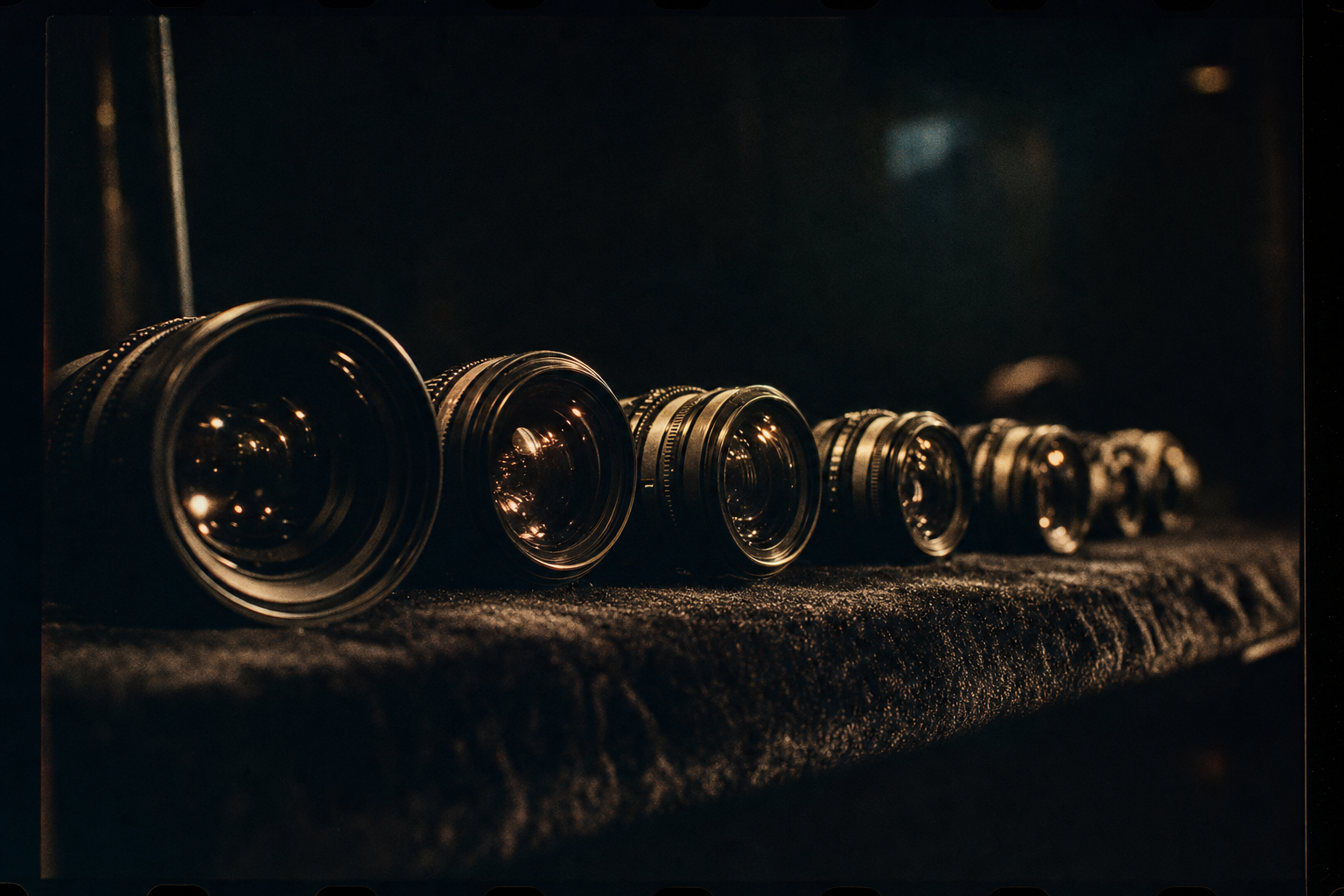
The Principle
Bradford Young photographs darkness — not as the absence of light but as a PRESENCE, a space of possibility, safety, and beauty. His images are among the most underexposed in mainstream cinema: shadows that other cinematographers would fill with bounce light, Young leaves BLACK. Faces emerge from these shadows like subjects of a Caravaggio painting, revealed only as much as the scene demands, the rest left to the imagination of the dark.
This is not merely an aesthetic preference. Young has spoken eloquently about the politics of exposure — how the history of film stock was calibrated for white skin, how "proper exposure" has always been a culturally specific concept, how darkness in cinema has been coded as threat rather than embrace. His work reclaims shadow as a place where Black bodies can exist with dignity, beauty, and complexity. When he photographs dark-skinned actors in Selma or When They See Us, the skin GLOWS against his shadows — rich, warm, dimensional. The darkness is not hiding them. It is CRADLING them.
His breakthrough into studio cinema — Arrival for Denis Villeneuve, Solo for Lucasfilm — proved that his shadow-forward approach could work at any scale. The heptapod ship interior in Arrival, shrouded in fog and darkness, is one of the most haunting science fiction spaces ever photographed. He earned the first Academy Award nomination for cinematography by an African American DP for that film, a recognition that arrived decades too late for the art form.
Light
The Underexposure Principle
Young consistently exposes 1-2 stops below what conventional cinematography would consider "correct." This is not a mistake or a limitation. It is a CHOICE that produces several effects: richer, more saturated colors in the midtones; deeper, more luminous shadows; skin tones that glow with internal light rather than reflecting external light; and a visual intimacy that draws the viewer INTO the image rather than holding them at a distance.
Selma (2014): The Selma-to-Montgomery marches — Young photographs Martin Luther King Jr. (David Oyelowo) in conditions that most cinematographers would consider too dark. The faces of the marchers catch fragments of light — a sliver across the eyes, a glow on the cheekbone — while the rest of the image lives in shadow. The effect is not obscurity. It is REVERENCE. These faces are not fully revealed because they are too important to be casually illuminated. The light must EARN its way to them.
Arrival (2016): The interior of the heptapod vessel — a vast dark space where Louise Banks (Amy Adams) attempts communication with beings from another world. Young lit these sequences with a single overhead source (representing the aliens' gravitational light) and let the fog and atmospheric haze distribute it unevenly through the space. Faces appear and disappear in the mist. The darkness is not threatening. It is the MEDIUM OF COMMUNICATION — the space where meaning might emerge.
Practicals as Anchors
In Young's shadow-dominant images, practical light sources — candles, lamps, windows — become EVENTS. A single candle in a dark room is not decoration. It is the SUBJECT of the image, the sole point of warmth in a field of black. This gives his practicals extraordinary power: when he lights a candle, the audience FEELS the warmth because the surrounding darkness makes the light precious.
Color
Deep, saturated shadows. Because Young underexposes, his shadows retain color information that would be lost in a more conventionally exposed image. His blacks are not neutral — they lean warm (deep browns, dark ambers) or cool (navy, charcoal) depending on the emotional register. This gives his dark images a richness and DEPTH that pure black cannot achieve.
Skin as light source. Young's most distinctive color work is in skin tones. He photographs dark skin so that it appears to generate its own illumination — a warm glow that comes from within rather than bouncing off the surface. This is achieved through careful underexposure (protecting highlights in the skin), warm color temperature (2800K- 3200K range), and the physics of melanin, which absorbs and re-emits light differently than lighter skin.
The Arrival palette. Gray-green fog, cold steel surfaces, and the warm amber of terrestrial interiors (Louise's house, her daughter's room). The alien sections are almost colorless — the palette reduced to the gray of fog and the white of the heptapods' ink. This chromatic austerity makes the human scenes (warm, colored) feel like emotional refuges.
Composition / Camera
Negative space. Young's compositions frequently place the subject in a small portion of the frame, surrounded by darkness or blurred environment. The negative space is not empty. It is WEIGHTED — the darkness has mass, presence, the quality of a room you cannot quite see. This creates compositions that feel simultaneously intimate (the face is close) and vast (the surrounding space extends beyond perception).
The soft close-up. Young favors close-ups shot on long lenses with very shallow depth of field. The face is sharp. Everything else dissolves into soft abstraction. This isolates the emotional subject from its physical context — the character exists in a private world of feeling, separated from the mechanism of the plot.
Stillness. Young's camera tends toward restraint. He holds compositions, lets scenes play in sustained shots, resists the urge to cut or move when the emotional content is already present in the existing frame. This patience is particularly effective in his shadow-rich images: the longer you look, the more you see in the darkness.
Specifications
- Expose for the shadows. Set exposure 1-2 stops below conventional levels. The
shadows should be rich and dimensional, not crushed. The highlights (faces, practicals) should glow against this deeper field.
- Let darkness be beautiful. Do not fill shadows reflexively. Darkness is a positive
space — a place of rest, intimacy, and dignity. The viewer does not need to see everything. They need to FEEL the darkness as a presence.
- Skin is the subject. When photographing faces, treat skin tone as the primary
aesthetic element. Every skin tone has a specific relationship to light. FIND that relationship through exposure, color temperature, and angle — do not impose a generic lighting recipe.
- Practicals are precious. In a dark frame, every light source matters enormously.
A single candle can be the emotional center of the image. Treat practicals with the respect they deserve in a world of shadow.
- Patience. Hold the frame. Let the scene breathe. The emotional content will emerge
from the sustained encounter between the viewer and the image.