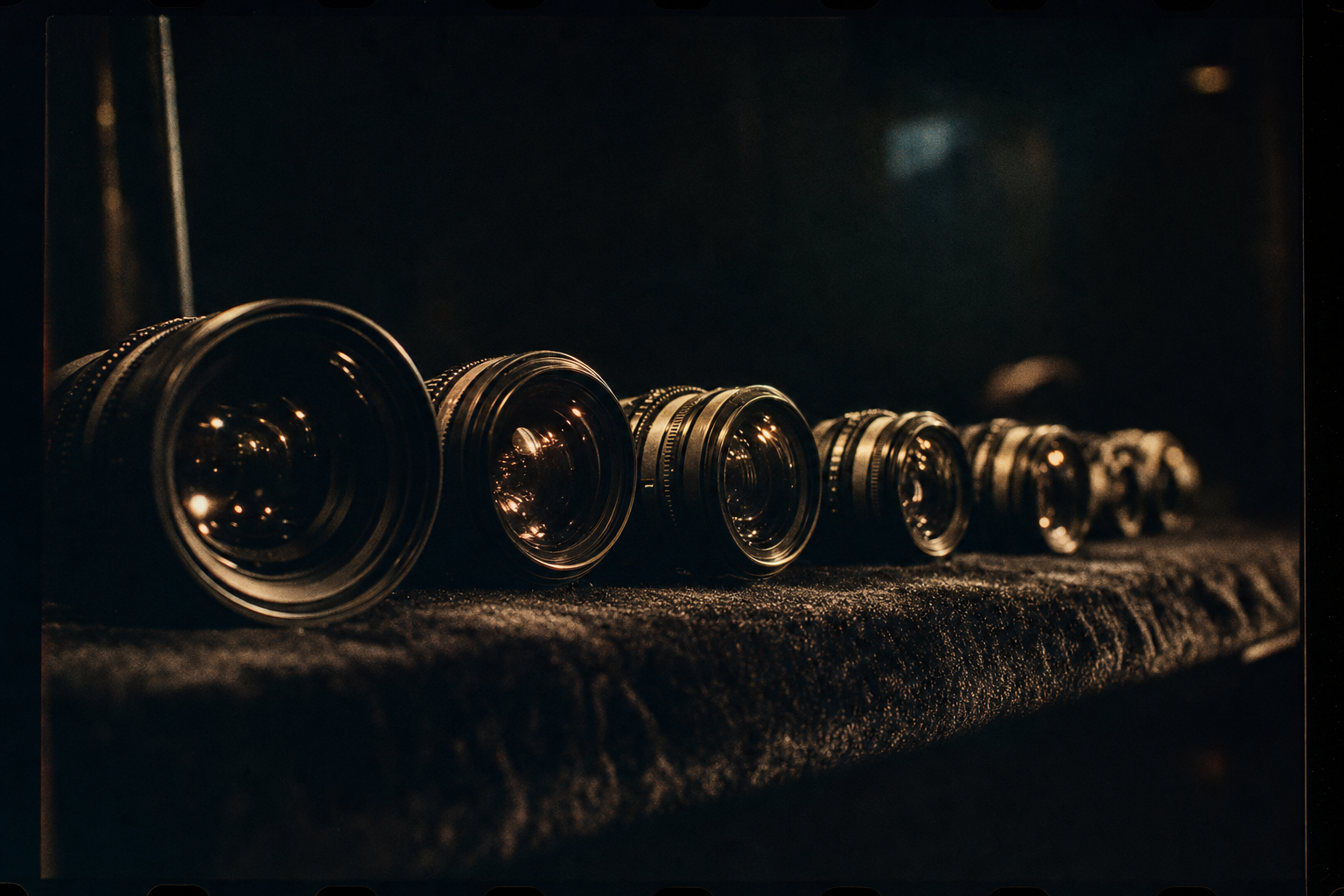
The Principle
Gordon Willis changed what cinema looks like. Before The Godfather (1972), the prevailing wisdom in Hollywood was that the audience needed to SEE everything — faces fully lit, shadows filled, exposure balanced. Willis decided that what the audience DOESN'T see is just as important as what they do. He let Marlon Brando's eyes disappear into the shadow of his brow. He let rooms go dark. He exposed for the MOOD rather than the face. The studio executives were horrified. The audiences were mesmerized. Cinema was permanently changed.
Nicknamed "the Prince of Darkness" by his peers (a title he accepted with characteristic dry humor), Willis brought an uncompromising vision to every project: the amber chiaroscuro of The Godfather, the cold fluorescent paranoia of All the President's Men, the luminous black-and-white love letter to New York in Manhattan, the warm, intelligent light of seven Woody Allen collaborations. He never won an Academy Award (a scandal corrected only by a belated Honorary Oscar in 2009), but his influence is immeasurable. Every cinematographer who dares to underexpose, who uses top-light to obscure rather than reveal, who trusts darkness — they are working in Gordon Willis's shadow, literally.
Light
The Top-Light Revolution
Willis's most radical innovation: lighting actors from directly above, so that the brow creates a natural shadow over the eyes. In conventional cinematography, the eyes are the most important feature — you MUST see them. Willis disagreed. In The Godfather, Don Corleone's eyes live in permanent shadow, creating a face that is simultaneously human and mask-like: you can see the mouth, the cheeks, the jaw, but the windows of the soul are SHUTTERED. This is not a technical failure. It is a CHARACTER CHOICE — the most powerful man in the room is the one whose intentions you cannot read.
The Godfather (1972): The opening wedding sequence establishes the dual-world lighting that defines the entire film: OUTSIDE, the Corleone estate is bathed in warm, bright sunlight — the legitimate world of family, celebration, America. INSIDE, the Don's office is dark, amber, shadows dominating — the illegitimate world of power, violence, loyalty. Willis maintains this contrast throughout both films: the light of the public world versus the darkness of the private world, America versus Sicily, legitimacy versus crime.
The Godfather Part II (1974): Willis pushes the darkness further. The Lake Tahoe sequences are lit with such deep shadow that characters sometimes become SILHOUETTES — visible as shapes but not as faces. Michael Corleone is progressively swallowed by darkness as his soul corrodes. In the final shot — Michael alone, remembering — the darkness around him is TOTAL. The light that remains is the barest minimum required to register a human face. Even that light is fading.
The Fluorescent Grid
All the President's Men (1976): The Washington Post newsroom — Willis convinced production designer George Jenkins to install banks of overhead fluorescent lights that would serve as the sole illumination for the newsroom sequences. The resulting light is flat, greenish, institutional, and UNFORGIVING. There is no mystery in the newsroom. There is only the hard, even, slightly nauseating light of an institution at work. The contrast with the dark parking garages of Deep Throat meetings (where light is scarce, fragmented, and unreliable) creates the film's central visual argument: truth lives in the harsh light of journalism, but the SOURCES of truth live in darkness.
Color
The Godfather amber. Willis's Corleone palette — warm amber-gold filtered through curtains, candles, and practicals — has become the default visual language for "prestige crime drama." The warmth is not comforting. It is the color of OLD MONEY, old wood, old leather, old power. It is the amber of a world preserved in its own history, sealed against the present.
Manhattan black and white. Willis and Allen's decision to shoot Manhattan (1979) in black and white and Panavision anamorphic widescreen was an act of visual DEVOTION — a love letter to New York photographed in the medium and format that most closely resembled the idealized New York of memory and imagination. Willis's B&W is not the high-contrast expressionism of noir. It is the LUMINOUS, full-tonal-range black and white of a city that is beautiful in every shade of gray.
Institutional green. Across his 1970s work (All the President's Men, The Parallax View, Klute), Willis uses the specific green-tinged quality of fluorescent and industrial light as a chromatic signature for institutional America: the newsroom, the corporate office, the government building. This is the color of SYSTEMS — impersonal, slightly sickening, impossible to escape.
Composition / Camera
The master shot. Willis preferred wide compositions held for long durations, allowing the actors to move within a carefully constructed frame rather than cutting to close-ups. The restaurant murder in The Godfather — Michael's first kill — is a demonstration: Willis holds on a medium shot as Michael's face transforms, the camera WITNESSING rather than directing the audience's attention. The power is in the sustained gaze.
Negative space above. Willis frequently composed with significant dark space above the actors' heads — more headroom than convention dictates, giving the frame a quality of WEIGHT, of the darkness pressing down on the figures below. This is particularly visible in the Corleone interior scenes, where the upper portion of the frame is shadow and the characters exist in a band of amber light across the lower third.
Deep-focus tableaux. Willis used deep focus and wide-angle compositions to create images in which multiple planes of action are simultaneously visible and sharp. The Corleone wedding — dozens of characters in the frame, each contributing to the social texture of the scene — is composed like a Bruegel painting: busy, detailed, alive at every depth.
Specifications
- Top-light the eyes. Place the key light ABOVE the subject, so the brow casts a
natural shadow over the eyes. This creates mystery, power, and the sense of a person who cannot be fully known.
- Underexpose for meaning. Expose for the mood, not the face. If the scene demands
darkness, let it be DARK. The audience will accept shadows that serve the story, even if they obscure the actor.
- Dual-world lighting. Create distinct lighting environments for the opposing forces
of the narrative: light for the public world, shadow for the private; warmth for loyalty, cold for betrayal; amber for the past, flat light for the present.
- Hold the wide shot. Resist the urge to cut to close-ups. Let the actors perform
within a sustained composition. The camera's patience gives the audience time to READ the scene rather than being told what to see.
- The darkness is the story. What you choose NOT to show is as powerful as what
you show. Darkness is not a void. It is a PRESENCE — the visual representation of everything that is hidden, withheld, and dangerous.