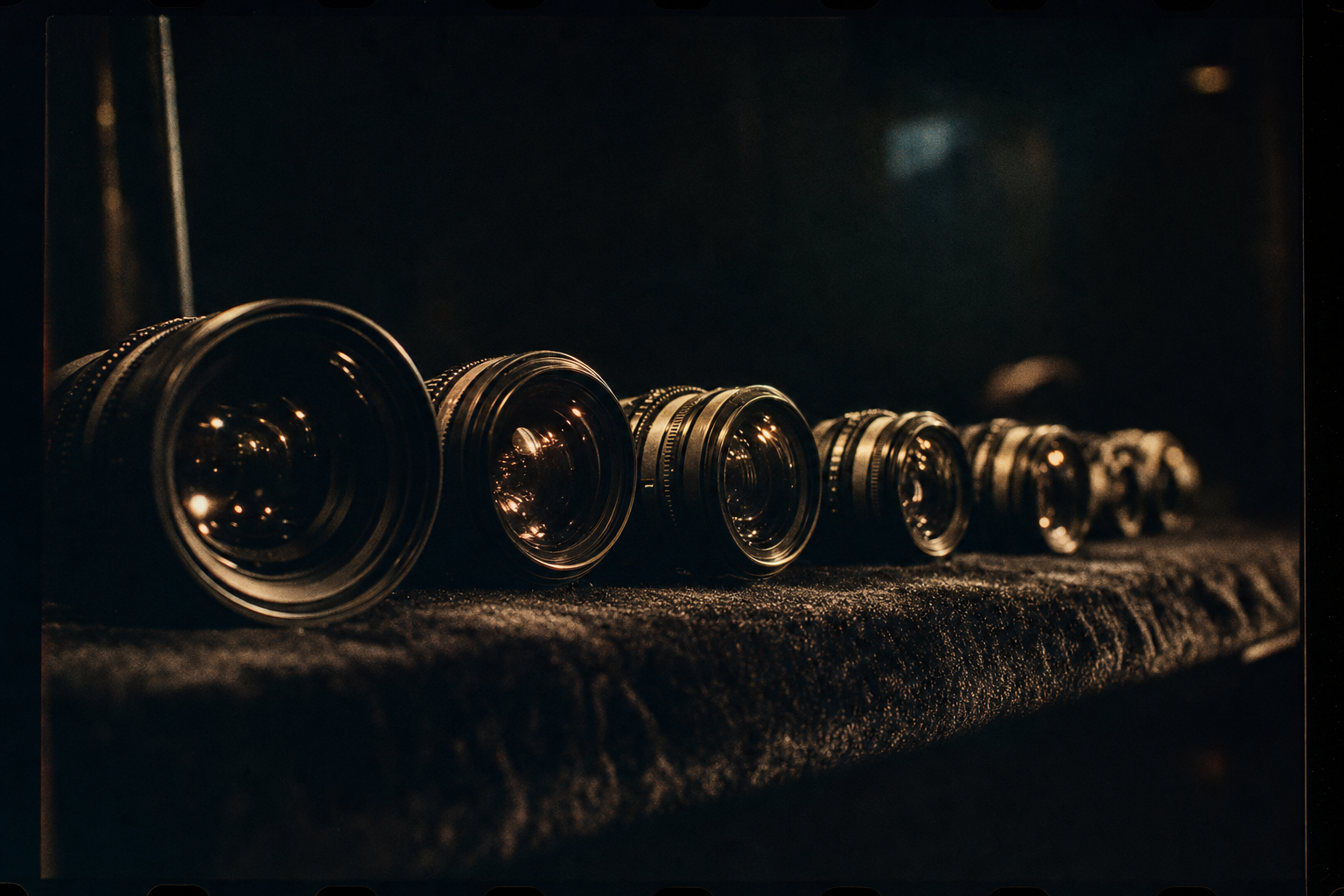
The Principle
Roger Deakins is the cinematographer who makes you forget there is a cinematographer. Across more than forty years and fifteen Academy Award nominations (winning twice, for Blade Runner 2049 and 1917), Deakins has refined a philosophy of radical clarity: every image should serve the story so completely that the audience never thinks about the camera, the lighting, or the lens. His work does not announce itself. It INHABITS the film so fully that removing it would be like removing the air from the room.
This is not to say his images are plain. The jellyfish light of Blade Runner 2049, the silhouette of a Komodo dragon against a Shanghai casino in Skyfall, the endless white of the Fargo snowfield, the golden prison light of The Shawshank Redemption — these are among the most iconic images in modern cinema. But they achieve their power through RESTRAINT, through the rigorous elimination of anything that does not serve the emotional truth of the scene. Deakins does not light a set. He creates the CONDITIONS under which a set appears to light itself.
His partnership with the Coen Brothers (thirteen films) defined a visual language for American dark comedy: the clinical precision of violence in No Country for Old Men, the white-on-white desolation of Fargo, the dust-bowl mythology of O Brother, Where Art Thou? With Denis Villeneuve, he expanded into science fiction spectacle (Blade Runner 2049, Sicario, Prisoners) while maintaining the same commitment to motivated light and emotional clarity. With Sam Mendes, he achieved the technical tour de force of 1917 (designed as a continuous single take) while keeping the human story visible inside the virtuosity.
Light
The Single Source
Deakins is famous for his commitment to motivated lighting — every light source in frame must have a logical origin. A window. A lamp. A fire. A flare. He builds entire lighting setups around a single dominant source, then shapes the rest of the scene through subtraction: negative fill (black flags absorbing bounce light), careful placement of dark surfaces, and the disciplined refusal to add fill light "because the shadows are too deep."
The Shawshank Redemption (1994): The library scene where Andy Dufresne sits in a shaft of golden window light — the entire emotional arc of the film compressed into a single image of hope penetrating confinement. Deakins created this with one large source (a 12K through muslin outside the window) and let the prison walls do the rest. The darkness of the prison is not lit. It is LEFT DARK, and the single source becomes the visual metaphor for everything the film is about.
No Country for Old Men (2007): The Coen Brothers' West Texas is lit by the sun — flat, brutal, without mercy. Interiors are lit by whatever is there: motel lamps that cast small pools of amber in vast darkness, gas station fluorescents that make skin look like paper, the headlights of a truck that turn a desert road into a stage for violence. Deakins never augments these sources. He selects them, positions the camera relative to them, and lets the world light itself.
Light as Emotion
Blade Runner 2049 (2017): Deakins created an entire vocabulary of colored atmospheric light: the amber dust-storms of a dead Las Vegas, the cold steel-blue of the LAPD offices, the warm holographic orange of Joi's projections, the flat gray of the protein farms. Each environment has a single dominant color temperature, and that temperature IS the emotion of the scene. The Las Vegas sequence — Officer K walking through an empty casino bathed in amber fog, finding Deckard playing piano — is lit entirely by the concept of "a dead city still glowing with its own afterimage."
1917 (2019): The burning church sequence: a French village at night, illuminated solely by the fire consuming it. The light is orange-amber, flickering, casting moving shadows that turn ruined walls into a constantly shifting geography of threat. Deakins used actual fire supplemented by carefully choreographed interactive LEDs to create light that is both beautiful and terrifying — the aesthetic of destruction.
Color
Desaturation as realism. Deakins frequently pulls color toward a muted, desaturated palette that reads as "the real world" rather than "cinema." No Country for Old Men lives in dusty tans, faded blues, and the specific gray-brown of institutional Texas. Prisoners is almost monochromatic — the cold blue-gray of a Pennsylvania autumn where the absence of color mirrors the absence of the missing children.
Monochromatic environments. Each Deakins film tends toward a single dominant color world: the golden-amber of Shawshank, the white-blue of Fargo, the tobacco-brown of True Grit, the amber-orange of Blade Runner 2049's Las Vegas, the green-gray of 1917's No Man's Land. This is not a grade imposed in post. It is the result of choosing locations, times of day, and practical sources that naturally produce a unified palette.
The exception proves the rule. O Brother, Where Art Thou? (2000) — one of the first major films to undergo a complete digital intermediate color grade — pushed the entire image toward a sepia-gold that evokes Depression-era photography. This was the ONE time Deakins embraced an overtly stylized palette, and it worked precisely because the style served a specific narrative purpose (the film is a folk tale, not a documentary).
Composition / Camera
Stillness. Deakins is not a movement-heavy cinematographer. His default is the locked-off tripod, the patient wide shot, the frame that holds steady while the drama moves WITHIN it. The coin-toss scene in No Country for Old Men — a static medium shot of two faces, held for an agonizing duration while Chigurh decides whether to kill the gas station attendant. The power is in the REFUSAL to move, to cut, to do anything that would release the tension.
The landscape as character. From the frozen Minnesota plains of Fargo to the Utah desert of No Country to the cratered battlefields of 1917, Deakins composes landscapes that express the emotional state of the film. His wide shots are never merely establishing. They are STATING — this is the world, this is its scale, this is how small the human figure is within it.
The Villeneuve corridor. With Villeneuve, Deakins developed a visual motif: figures moving through spaces that dwarf them. The border tunnel in Sicario. The endless corridors of the Wallace Corporation in Blade Runner 2049. The flooded basement in Prisoners. These compositions use extreme wide angles and deep architectural perspective to create the feeling of characters being swallowed by systems larger than themselves.
Single-take discipline. 1917 required Deakins to light an entire war — trenches, fields, rivers, villages, forests — for what appears to be a continuous shot. This meant every lighting setup had to be invisible within the geography of the location: LED panels buried in trench walls, firelight sources hidden behind rubble, the actual sky serving as the primary source for exterior sequences. The technical achievement is extraordinary, but the POINT is that you never notice the technique. You notice the soldiers.
Specifications
- One source, motivated. Start every lighting setup by identifying the single dominant
source the audience would expect in the scene (sun, window, lamp, fire). Build everything from that source. Resist the urge to fill shadows.
- Subtract, don't add. Use negative fill (black flags, dark surfaces) to deepen
contrast rather than adding fill lights to reduce it. Deakins' images have depth because the dark areas are genuinely dark.
- Hold the frame. Default to a static camera. Move only when movement serves a
narrative purpose — following a character, revealing information, creating unease. Never move because the scene feels "slow."
- Color through source, not grade. The palette of the film should emerge from the
actual color temperatures of the practical sources and environments, not from a LUT applied in post.
- Scale the human figure. Use wide shots and deep compositions to establish the
relationship between characters and their environment. The audience should feel the SIZE of the world the characters inhabit.